
Grading
AI grading you can stand behind.
Traverse grades your existing assessments against your own rubrics: consistent, defensible, and at a fraction of the cost of human marking.
Grading
AI grading you can stand behind.
Traverse grades your existing assessments against your own rubrics: consistent, defensible, and at a fraction of the cost of human marking.
Grading
AI grading you can stand behind.
Traverse grades your existing assessments against your own rubrics: consistent, defensible, and at a fraction of the cost of human marking.
Grading
AI grading you can stand behind.
Traverse grades your existing assessments against your own rubrics: consistent, defensible, and at a fraction of the cost of human marking.

THE SOLUTION
Why AI grading?
Really good AI grading delivers consistency, scale, and transparency at the same time. The three properties that matter most for defensible assessment at any volume.
THE SOLUTION
Why AI grading?
Really good AI grading delivers consistency, scale, and transparency at the same time. The three properties that matter most for defensible assessment at any volume.
THE SOLUTION
Why AI grading?
Really good AI grading delivers consistency, scale, and transparency at the same time. The three properties that matter most for defensible assessment at any volume.
THE SOLUTION
Why AI grading?
Really good AI grading delivers consistency, scale, and transparency at the same time. The three properties that matter most for defensible assessment at any volume.
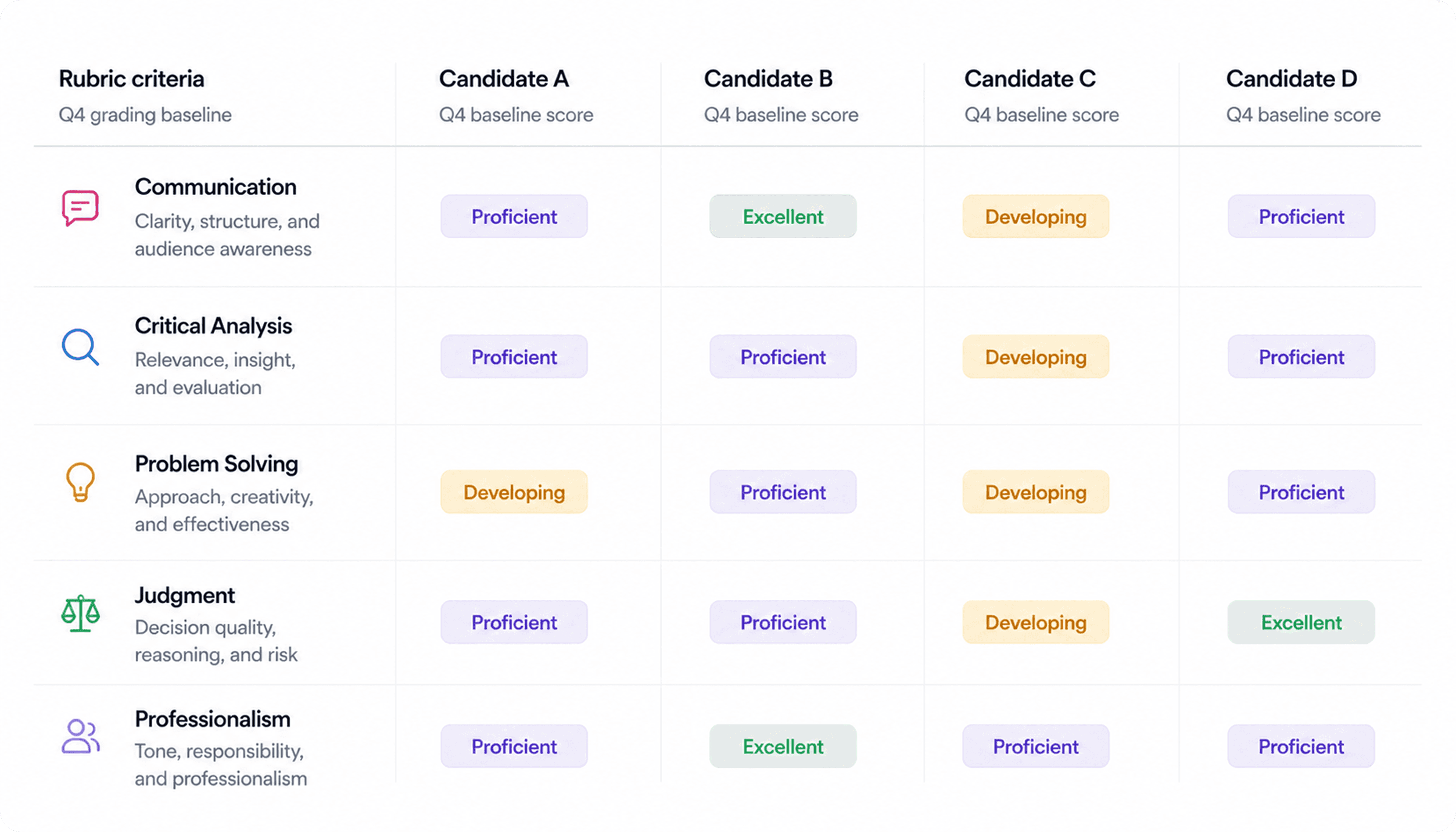
Consistency
The same standard on every submission.
Every candidate is graded against the same rubric, the same way. No fatigue, no bias, no grader-order effects. That consistency is a reliability gain, and reliability is the foundation of defensible assessment.
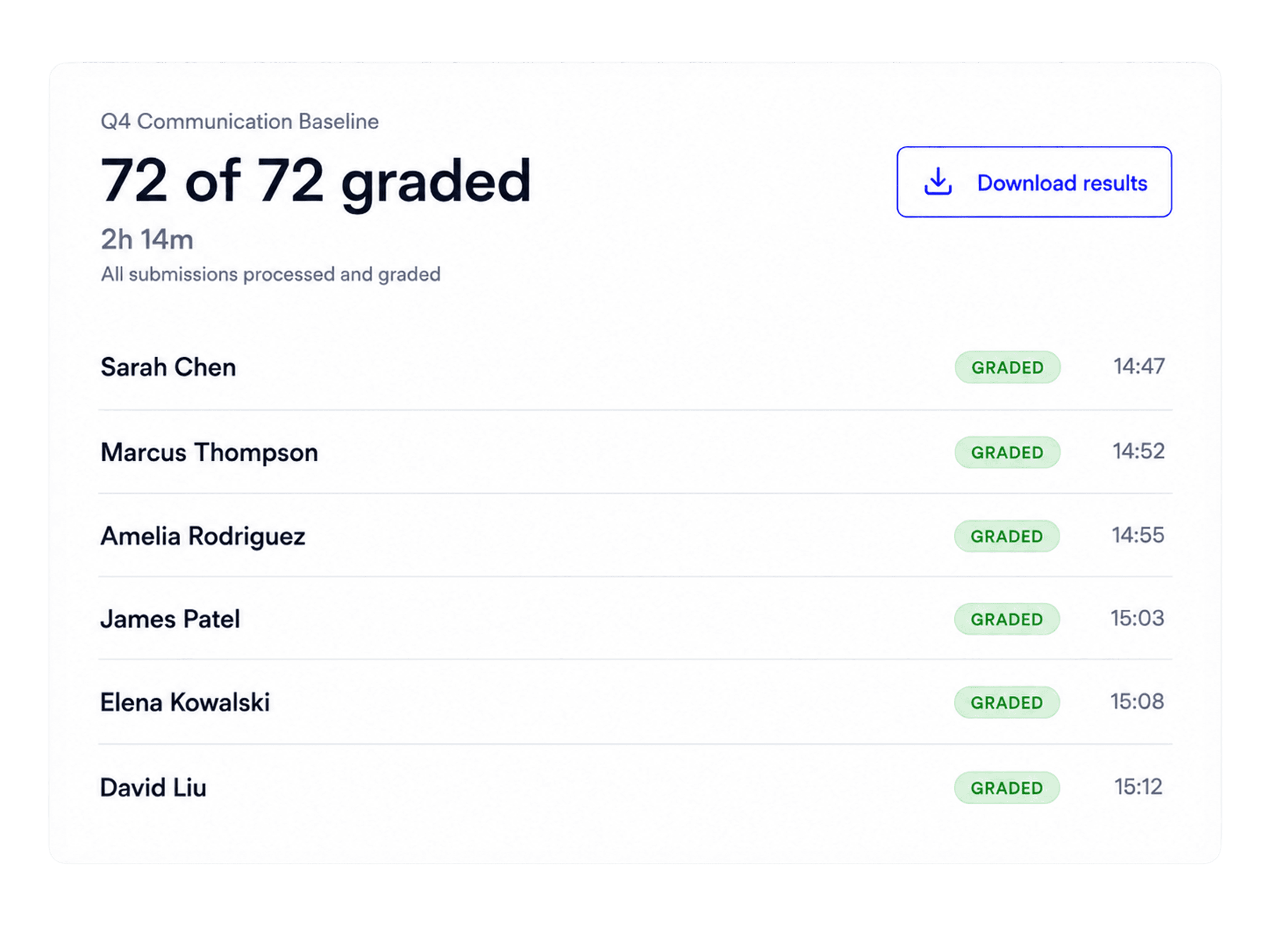
Scale and cost
Hours instead of weeks.
Our customers estimate AI grading saves them up to 90% of the time of equivalent human marking. Candidates receive results within hours of submission. Your subject-matter experts are freed from repetitive rubric application to focus on training, coaching, and work where their judgment adds real value.
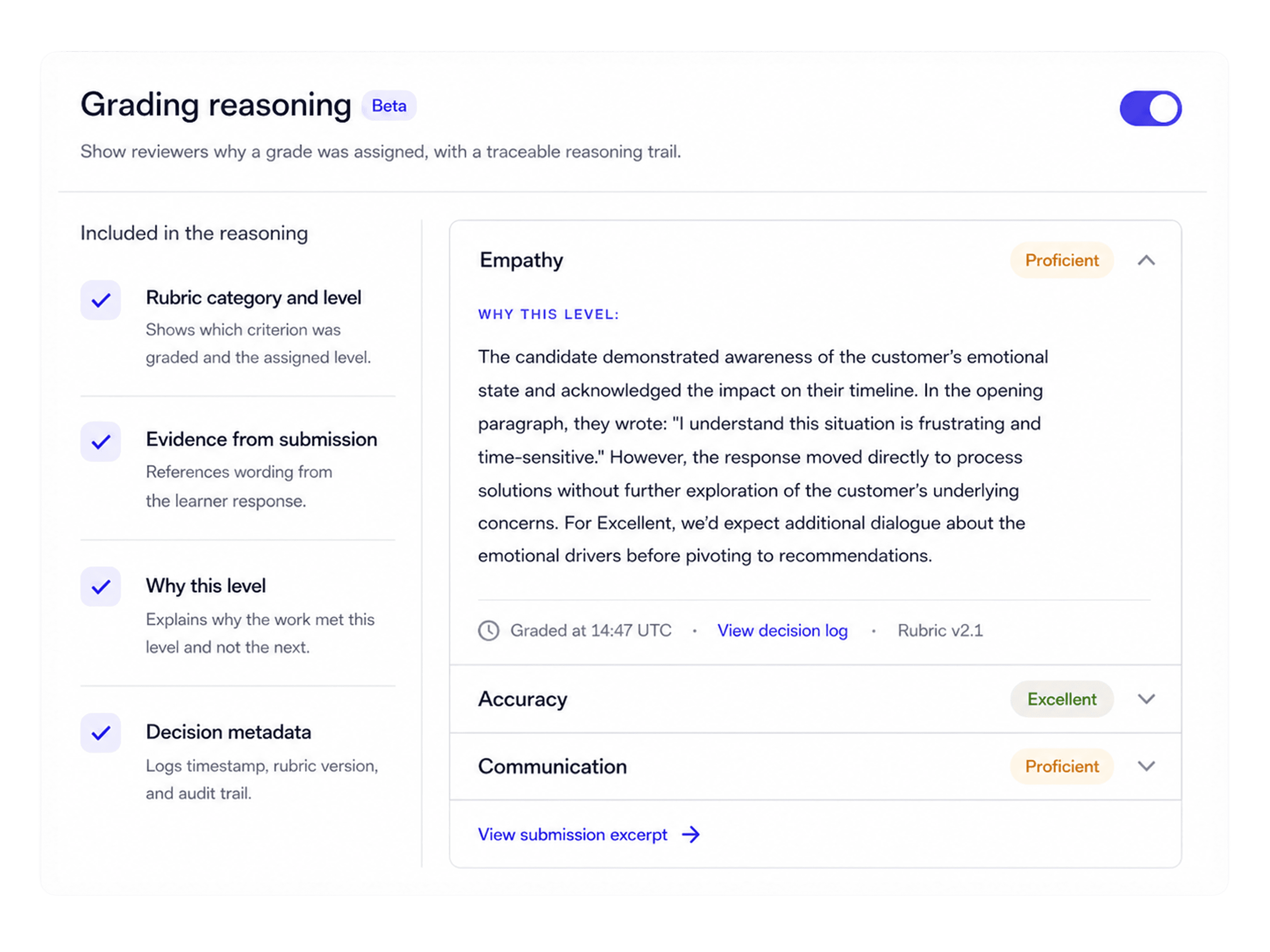
Transparency
Auditable by design
Every grading decision is logged: which rubric criteria were applied, what the submission contained against each, and what reasoning led to the outcome. Any result can be inspected, audited, or challenged.
Consistency
The same standard on every submission.
Every candidate is graded against the same rubric, the same way. No fatigue, no bias, no grader-order effects. That consistency is a reliability gain, and reliability is the foundation of defensible assessment.
Scale and cost
Hours instead of weeks.
Our customers estimate AI grading saves them up to 90% of the time of equivalent human marking. Candidates receive results within hours of submission. Your subject-matter experts are freed from repetitive rubric application to focus on training, coaching, and work where their judgment adds real value.
Transparency
Auditable by design
Every grading decision is logged: which rubric criteria were applied, what the submission contained against each, and what reasoning led to the outcome. Any result can be inspected, audited, or challenged.
Consistency
The same standard on every submission.
Every candidate is graded against the same rubric, the same way. No fatigue, no bias, no grader-order effects. That consistency is a reliability gain, and reliability is the foundation of defensible assessment.
Scale and cost
Hours instead of weeks.
Our customers estimate AI grading saves them up to 90% of the time of equivalent human marking. Candidates receive results within hours of submission. Your subject-matter experts are freed from repetitive rubric application to focus on training, coaching, and work where their judgment adds real value.
Transparency
Auditable by design
Every grading decision is logged: which rubric criteria were applied, what the submission contained against each, and what reasoning led to the outcome. Any result can be inspected, audited, or challenged.
Consistency
The same standard on every submission.
Every candidate is graded against the same rubric, the same way. No fatigue, no bias, no grader-order effects. That consistency is a reliability gain, and reliability is the foundation of defensible assessment.
Scale and cost
Hours instead of weeks.
Our customers estimate AI grading saves them up to 90% of the time of equivalent human marking. Candidates receive results within hours of submission. Your subject-matter experts are freed from repetitive rubric application to focus on training, coaching, and work where their judgment adds real value.
Transparency
Auditable by design
Every grading decision is logged: which rubric criteria were applied, what the submission contained against each, and what reasoning led to the outcome. Any result can be inspected, audited, or challenged.
The outcomes
What changes when grading works.
The outcomes
What changes when grading works.
Turnaround time
3 – 4 weeks
Scheduling markers, coordinating scripts, and managing the review cycle adds weeks to every assessment. Candidates wait without visibility into where things stand.
grading consistency
Depends on the marker
Different markers apply the rubric differently. Fatigue, workload, and grader-order effects introduce variance that no moderation process fully resolves.
Feedback quality
Generic – if any
Feedback is expensive to write at scale, so most candidates receive a grade and a comment. The specificity that makes feedback developmental rarely survives a high-volume marking cycle.
Cost per script
£40 – 60
Human marking is priced per submission. At scale, the economics constrain what formats are viable — richer assessments stay off the roadmap because the marking cost makes them impractical.
student experience
Weeks of silence
Candidates submit and wait, with no visibility into progress or timeline. By the time results arrive, the work, and any opportunity to act on the feedback, is weeks behind them
audit trail
Marker notes, if you're lucky
The reasoning behind a grading decision lives in a marker's head or in sparse notes. If a result is challenged, reconstructing the evidence is slow, inconsistent, and often incomplete.
Turnaround time
< 24 hours
Grading runs as submissions arrive. Candidates receive their result and criterion-level feedback within hours of submitting, while the work is still fresh and the feedback can still land.
grading consistency
Calibrated – same rubric, same result
Every submission is graded against the same rubric, the same way, from the first script to the ten-thousandth. No fatigue, no drift, no grader-order effects.
Feedback quality
Criterion-level, with reasoning
Every candidate receives structured feedback mapped to each rubric criterion, showing where they performed strongly, where they fell short, and why. Specific enough to act on, generated at any volume.
Cost per script
< £1
AI grading compresses the per-submission cost from tens of pounds to pennies. Programmes that were previously too expensive to run at scale become viable, and the savings compound with every assessment cycle.
student experience
Same-day feedback they can learn from
Candidates submit and hear back the same day, with feedback specific to their work. Results arrive while the experience is still present, making the feedback genuinely useful rather than a record of something weeks behind them.
audit trail
Full reasoning for every decision
Every grading decision is logged: rubric criteria applied, evidence drawn from the submission, and the reasoning behind the outcome. Any result can be inspected, challenged, or exported at any time.
The feedback experience
Every candidate gets feedback they can talk to.
The feedback experience
Every candidate gets feedback they can talk to.
The feedback experience
Every candidate gets feedback they can talk to.
The feedback experience
Every candidate gets feedback they can talk to.
The scorecard
Every criterion scored. Every score explained.
Every candidate receives feedback mapped to what they actually wrote, scored against each rubric criterion, with reasoning for where they landed and what would have moved them up. Delivered the same day, at any volume.
A score and a proficiency level for each rubric criterion, showing exactly where the candidate performed strongly and where they fell short
Written reasoning per criterion, drawn from the submission itself, not a template response
Delivered within hours of submission, for every candidate, at a fraction of the cost of human marking
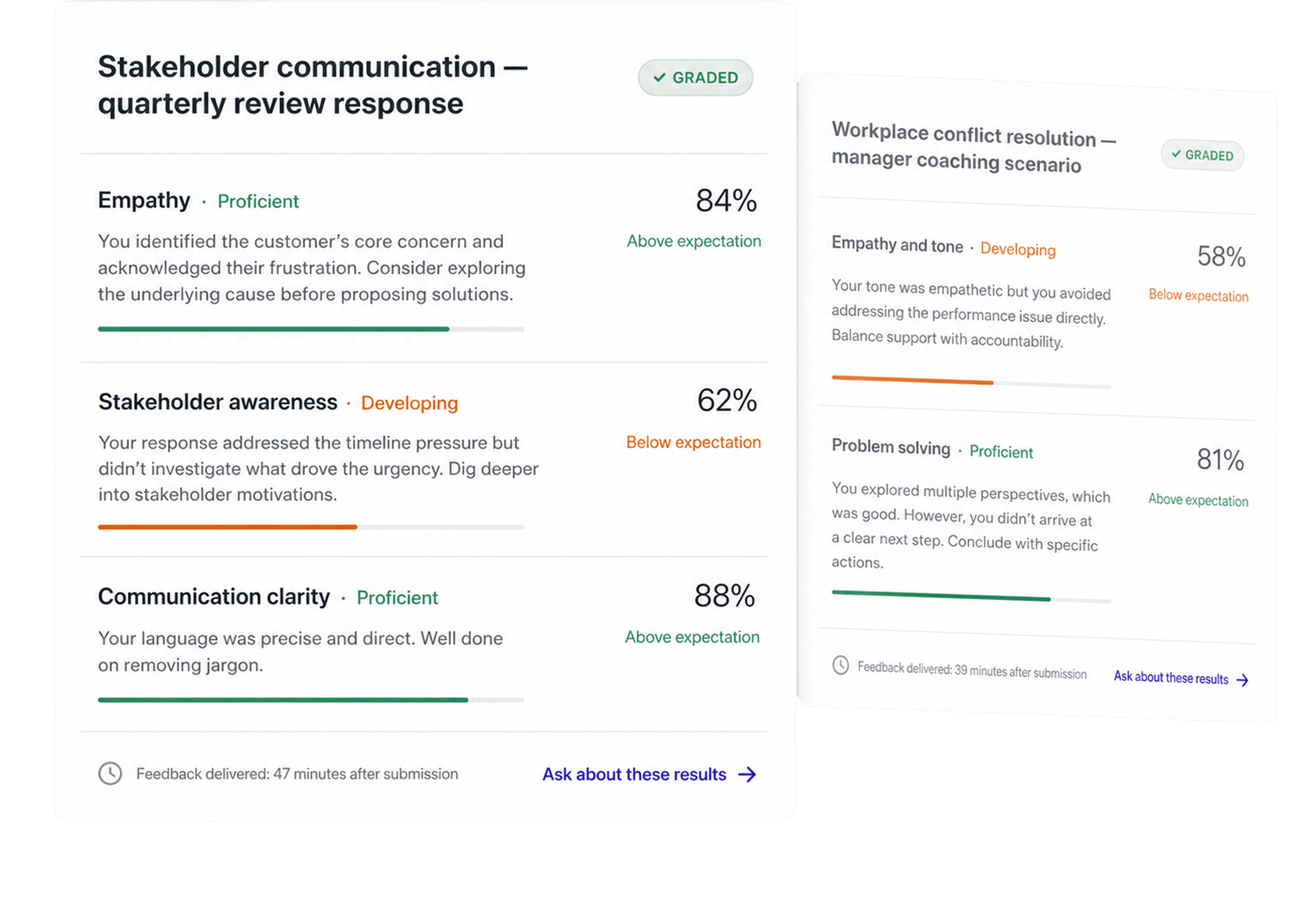
The scorecard
Every criterion scored. Every score explained.
Every candidate receives feedback mapped to what they actually wrote, scored against each rubric criterion, with reasoning for where they landed and what would have moved them up. Delivered the same day, at any volume.
A score and a proficiency level for each rubric criterion, showing exactly where the candidate performed strongly and where they fell short
Written reasoning per criterion, drawn from the submission itself, not a template response
Delivered within hours of submission, for every candidate, at a fraction of the cost of human marking
The scorecard
Every criterion scored. Every score explained.
Every candidate receives feedback mapped to what they actually wrote, scored against each rubric criterion, with reasoning for where they landed and what would have moved them up. Delivered the same day, at any volume.
A score and a proficiency level for each rubric criterion, showing exactly where the candidate performed strongly and where they fell short
Written reasoning per criterion, drawn from the submission itself, not a template response
Delivered within hours of submission, for every candidate, at a fraction of the cost of human marking
The scorecard
Every criterion scored. Every score explained.
Every candidate receives feedback mapped to what they actually wrote, scored against each rubric criterion, with reasoning for where they landed and what would have moved them up. Delivered the same day, at any volume.
A score and a proficiency level for each rubric criterion, showing exactly where the candidate performed strongly and where they fell short
Written reasoning per criterion, drawn from the submission itself, not a template response
Delivered within hours of submission, for every candidate, at a fraction of the cost of human marking
The conversation
Then they can ask about it.
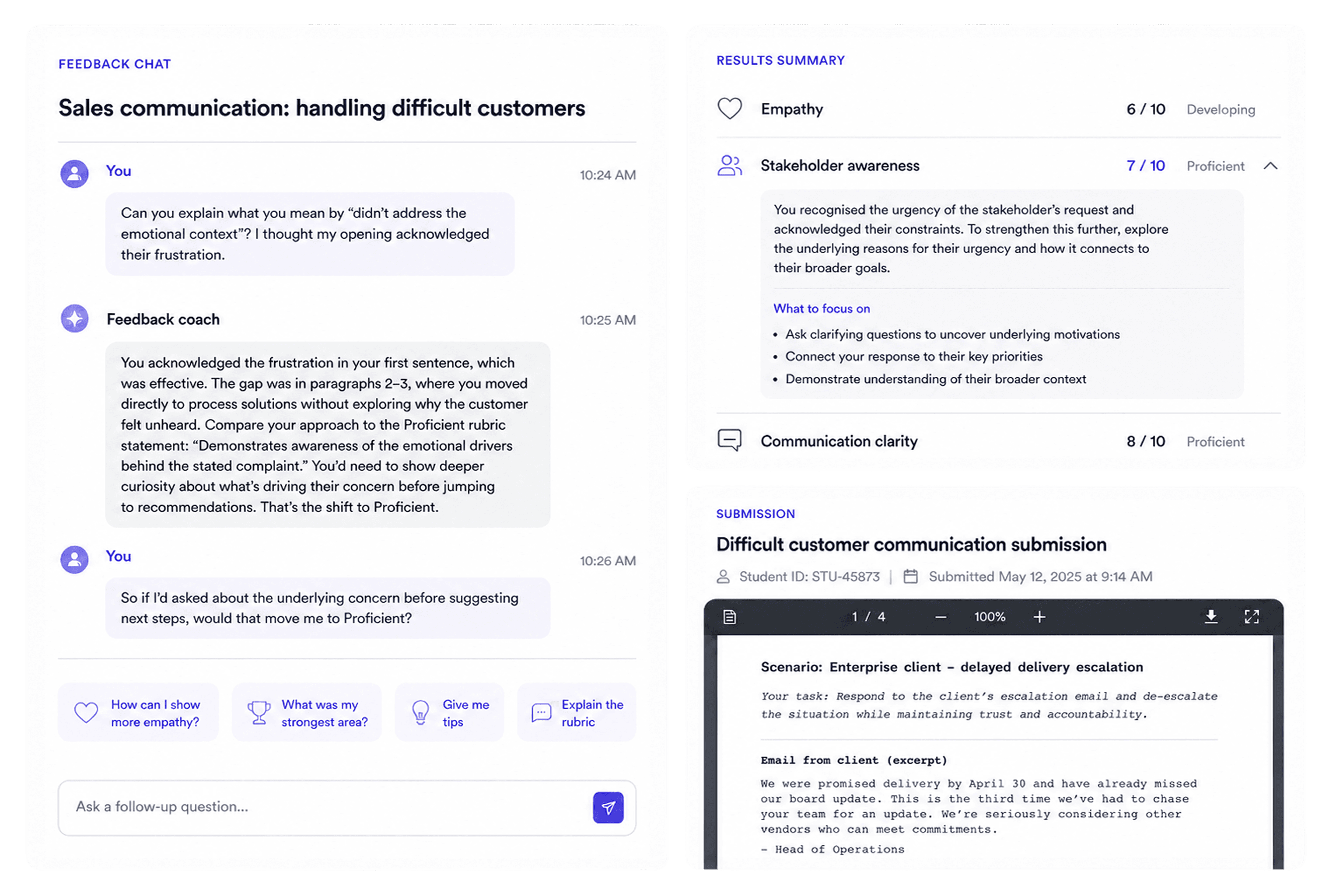
Candidates can ask about any part of their result and get a specific, reasoned answer back. Not a template. An answer that references what they actually wrote, explains what stronger performance would have looked like, and builds on prior results over time.
Candidates can challenge any criterion result and receive a reasoned response grounded in their submission
The feedback can explain what a higher-level response would have needed to demonstrate, criterion by criterion
Prior performance shapes subsequent feedback, so development conversations build rather than reset with each assessment
The conversation
Then they can ask about it.
Candidates can ask about any part of their result and get a specific, reasoned answer back. Not a template. An answer that references what they actually wrote, explains what stronger performance would have looked like, and builds on prior results over time.
Candidates can challenge any criterion result and receive a reasoned response grounded in their submission
The feedback can explain what a higher-level response would have needed to demonstrate, criterion by criterion
Prior performance shapes subsequent feedback, so development conversations build rather than reset with each assessment
The conversation
Then they can ask about it.
Candidates can ask about any part of their result and get a specific, reasoned answer back. Not a template. An answer that references what they actually wrote, explains what stronger performance would have looked like, and builds on prior results over time.
Candidates can challenge any criterion result and receive a reasoned response grounded in their submission
The feedback can explain what a higher-level response would have needed to demonstrate, criterion by criterion
Prior performance shapes subsequent feedback, so development conversations build rather than reset with each assessment
The conversation
Then they can ask about it.
Candidates can ask about any part of their result and get a specific, reasoned answer back. Not a template. An answer that references what they actually wrote, explains what stronger performance would have looked like, and builds on prior results over time.
Candidates can challenge any criterion result and receive a reasoned response grounded in their submission
The feedback can explain what a higher-level response would have needed to demonstrate, criterion by criterion
Prior performance shapes subsequent feedback, so development conversations build rather than reset with each assessment
How we build it
The work is the rubric.
How we build it
The work is the rubric.
How we build it
The work is the rubric.
How we build it
The work is the rubric.
Rubric calibration
We design and calibrate the rubric with your subject-matter experts.
A staged workflow, from synthetic calibration through to live calibration and integrity checks, surfaces the edge cases first drafts always miss. Calibration continues after launch, and the system gets sharper with every cycle.
Confidence flagging
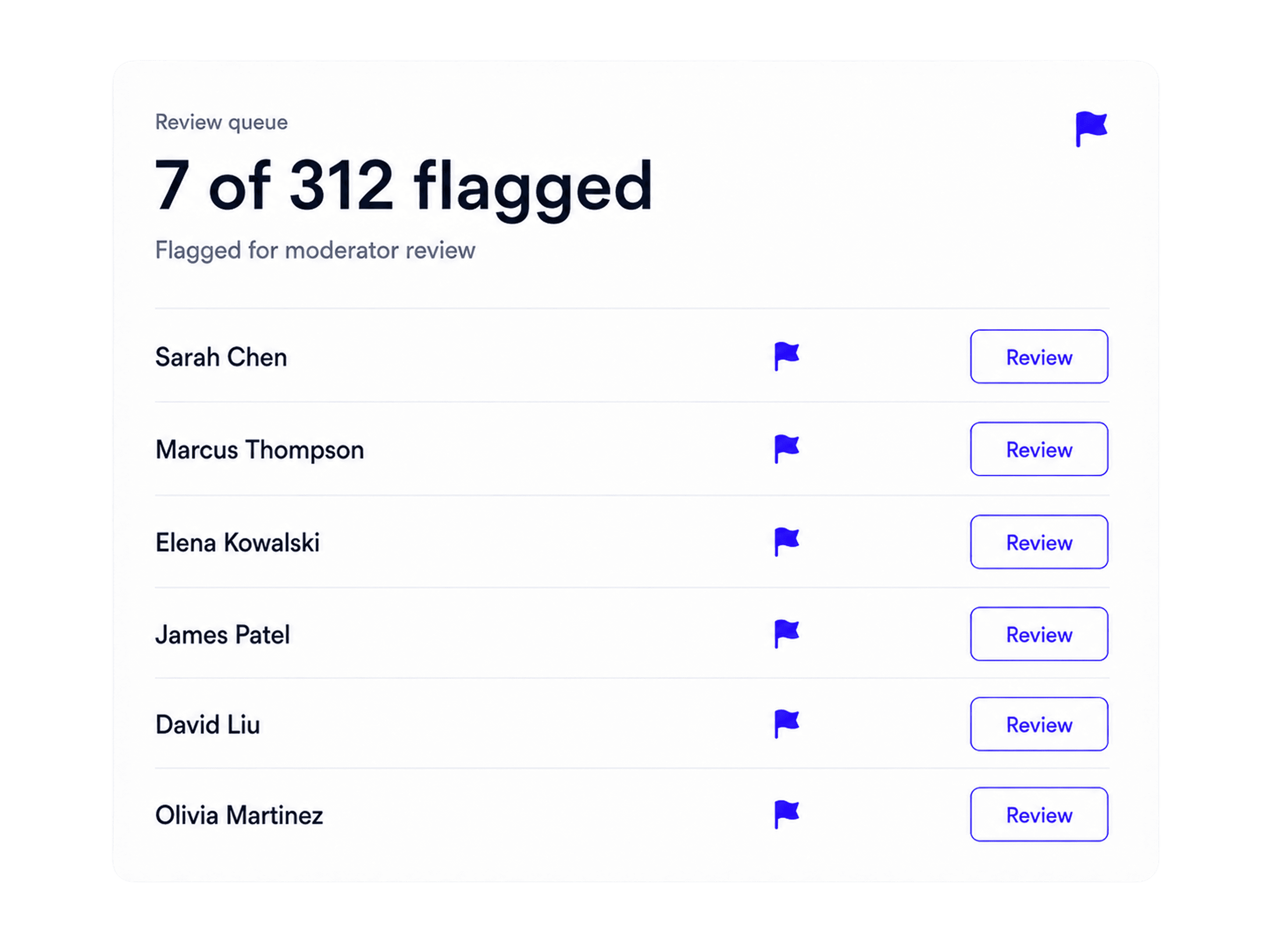
The system flags what it is unsure about.
Submissions at the boundary between levels, unusual approaches, or cases where rubric criteria conflict are surfaced for human review. Flags are a normal part of a well-run deployment, and the mechanism by which reliability is maintained at the edges of what the rubric was built to handle.
Rubric calibration
We design and calibrate the rubric with your subject-matter experts.
A staged workflow, from synthetic calibration through to live calibration and integrity checks, surfaces the edge cases first drafts always miss. Calibration continues after launch, and the system gets sharper with every cycle.
Confidence flagging
The system flags what it is unsure about.
Submissions at the boundary between levels, unusual approaches, or cases where rubric criteria conflict are surfaced for human review. Flags are a normal part of a well-run deployment, and the mechanism by which reliability is maintained at the edges of what the rubric was built to handle.
Rubric calibration
We design and calibrate the rubric with your subject-matter experts.
A staged workflow, from synthetic calibration through to live calibration and integrity checks, surfaces the edge cases first drafts always miss. Calibration continues after launch, and the system gets sharper with every cycle.
Confidence flagging
The system flags what it is unsure about.
Submissions at the boundary between levels, unusual approaches, or cases where rubric criteria conflict are surfaced for human review. Flags are a normal part of a well-run deployment, and the mechanism by which reliability is maintained at the edges of what the rubric was built to handle.
Rubric calibration
We design and calibrate the rubric with your subject-matter experts.
A staged workflow, from synthetic calibration through to live calibration and integrity checks, surfaces the edge cases first drafts always miss. Calibration continues after launch, and the system gets sharper with every cycle.
Confidence flagging
The system flags what it is unsure about.
Submissions at the boundary between levels, unusual approaches, or cases where rubric criteria conflict are surfaced for human review. Flags are a normal part of a well-run deployment, and the mechanism by which reliability is maintained at the edges of what the rubric was built to handle.
What you get
How you scale quality.
Our solutions experts work with your team to implement safe, reliable AI grading. Our expertise meets your context.
What you get
How you scale quality.
Our solutions experts work with your team to implement safe, reliable AI grading. Our expertise meets your context.
What you get
How you scale quality.
Our solutions experts work with your team to implement safe, reliable AI grading. Our expertise meets your context.
What you get
How you scale quality.
Our solutions experts work with your team to implement safe, reliable AI grading. Our expertise meets your context.

Rubric-level scores for every submission
A score and proficiency level against every rubric criterion, for every candidate, not just an overall grade.
Interrogable reasoning for every grade.
Every decision includes the reasoning behind it, so assessors can inspect, challenge, or override any result at any time.
Cohort analytics across programmes.
Performance data rolls up across all submissions, showing where candidates are consistently strong and where your programme needs attention.
Full audit trail for external assurance.
Every grading action is logged with a timestamp, rubric version, and full reasoning trail, ready for regulatory or quality-assurance scrutiny.
Exportable records for every candidate.
Criterion-level scores and reasoning export directly into your LMS, HR system, or reporting workflows.

Real examples
How it's being used now.
Global research university
Reduced grader pool by 90% processing over 70,000 scripts a year.
A global research university uses Traverse to grade complex postgraduate work against academic and professional benchmarks. Over 1,300 candidates were processed through the system in the first year of deployment, with consistency improving alongside the cost reduction.
%
Reduction in marking
%
Scripts
%
Candidates
Private higher education institution
32,000 submissions. 104 assessment types. One grading system.
A private higher education institution with campuses across South Africa uses Traverse to grade summative assessments across its full course catalogue: first year through final year, across five faculties including business, law, information technology, humanities, and education.
%
Submissions
%
Assessment types
%
Grading system
Real examples
How it's being used now.
Global research university
Reduced grader pool by 90% processing over 70,000 scripts a year.
A global research university uses Traverse to grade complex postgraduate work against academic and professional benchmarks. Over 1,300 candidates were processed through the system in the first year of deployment, with consistency improving alongside the cost reduction.
%
Reduction in marking
%
Scripts
%
Candidates
Private higher education institution
32,000 submissions. 104 assessment types. One grading system.
A private higher education institution with campuses across South Africa uses Traverse to grade summative assessments across its full course catalogue: first year through final year, across five faculties including business, law, information technology, humanities, and education.
%
Submissions
%
Assessment types
%
Grading system
Real examples
How it's being used now.
Global research university
Reduced grader pool by 90% processing over 70,000 scripts a year.
A global research university uses Traverse to grade complex postgraduate work against academic and professional benchmarks. Over 1,300 candidates were processed through the system in the first year of deployment, with consistency improving alongside the cost reduction.
%
Reduction in marking
%
Scripts
%
Candidates
Private higher education institution
32,000 submissions. 104 assessment types. One grading system.
A private higher education institution with campuses across South Africa uses Traverse to grade summative assessments across its full course catalogue: first year through final year, across five faculties including business, law, information technology, humanities, and education.
%
Submissions
%
Assessment types
%
Grading system
Real examples
How it's being used now.
Global research university
Reduced grader pool by 90% processing over 70,000 scripts a year.
A global research university uses Traverse to grade complex postgraduate work against academic and professional benchmarks. Over 1,300 candidates were processed through the system in the first year of deployment, with consistency improving alongside the cost reduction.
%
Reduction in marking
%
Scripts
%
Candidates
Private higher education institution
32,000 submissions. 104 assessment types. One grading system.
A private higher education institution with campuses across South Africa uses Traverse to grade summative assessments across its full course catalogue: first year through final year, across five faculties including business, law, information technology, humanities, and education.
%
Submissions
%
Assessment types
%
Grading system
Resources
How do you grade 1,000 assessments in 10 minutes?
Our perspective on what it actually is, how it works, and why it can be worth more to your business than you think.
Explore More
Learn more about Immersive Case Studies.
Realistic, multi-modal scenarios where candidates work through the situation as it actually unfolds, and how they handle it is what gets measured.
Match the scenario to the actual work with chat, email, voice, video, documents, and AI interactions.
Assess candidates on how they handle the work - judgment calls, competing demands, and ambiguous information - not what they know in isolation.
Build capability through the same experience that measures it: practice mode, feedback scorecards, and a rubric-backed record of performance.
Explore More
Learn more about Immersive Case Studies.
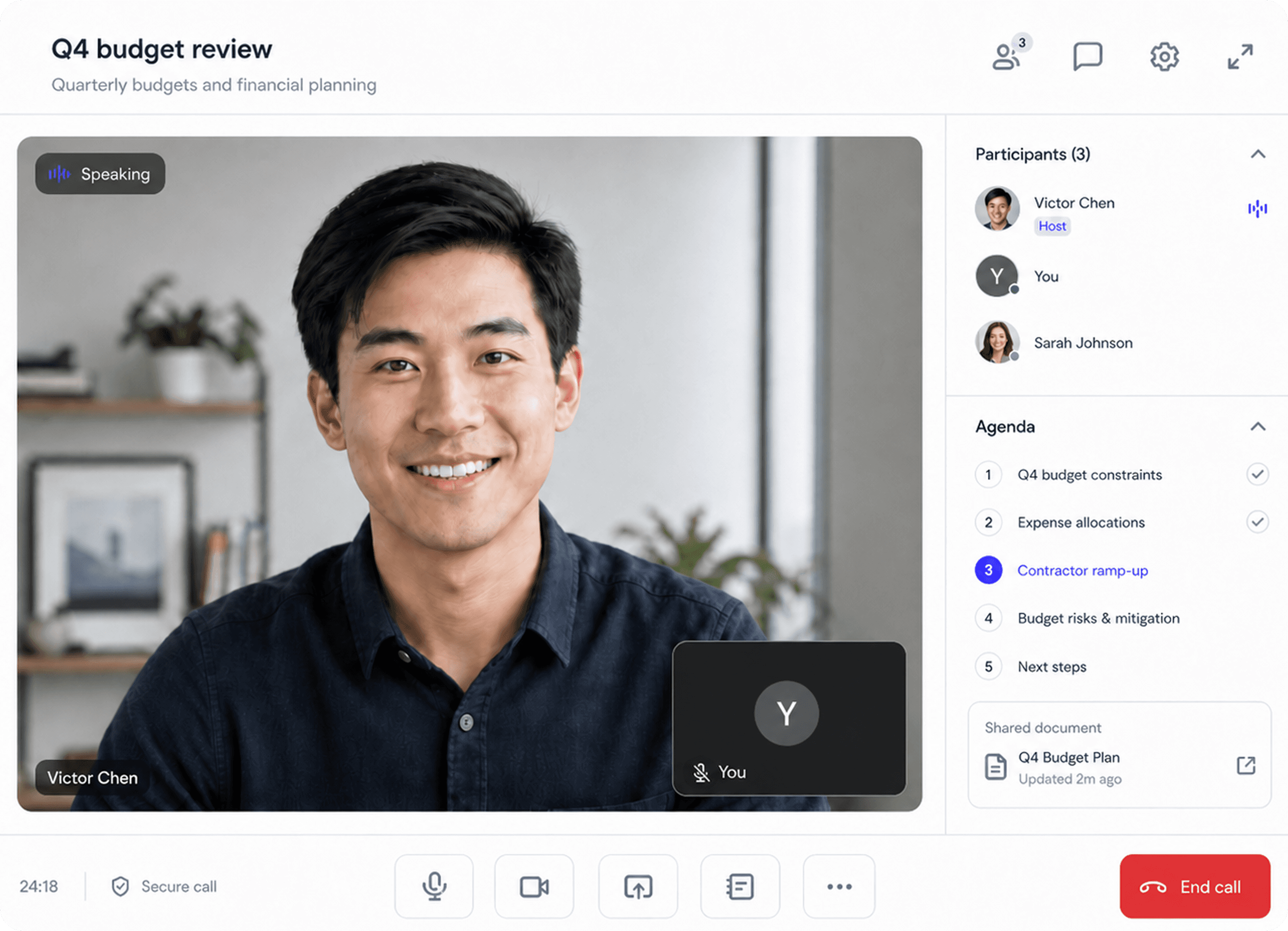
Realistic, multi-modal scenarios where candidates work through the situation as it actually unfolds, and how they handle it is what gets measured.
Match the scenario to the actual work with chat, email, voice, video, documents, and AI interactions.
Assess candidates on how they handle the work - judgment calls, competing demands, and ambiguous information - not what they know in isolation.
Build capability through the same experience that measures it: practice mode, feedback scorecards, and a rubric-backed record of performance.
Explore More
Learn more about Immersive Case Studies.
Realistic, multi-modal scenarios where candidates work through the situation as it actually unfolds, and how they handle it is what gets measured.
Match the scenario to the actual work with chat, email, voice, video, documents, and AI interactions.
Assess candidates on how they handle the work - judgment calls, competing demands, and ambiguous information - not what they know in isolation.
Build capability through the same experience that measures it: practice mode, feedback scorecards, and a rubric-backed record of performance.
Explore More
Learn more about Immersive Case Studies.
Realistic, multi-modal scenarios where candidates work through the situation as it actually unfolds, and how they handle it is what gets measured.
Match the scenario to the actual work with chat, email, voice, video, documents, and AI interactions.
Assess candidates on how they handle the work - judgment calls, competing demands, and ambiguous information - not what they know in isolation.
Build capability through the same experience that measures it: practice mode, feedback scorecards, and a rubric-backed record of performance.
Talk to us
Start with the shift that matters to you.
Explore the segment page for your organisation, or get in touch to talk through how the platform could fit.


Measure what matters. Prove it at scale.
Terms & Conditions
Privacy Policy
Measure what matters. Prove it at scale.
Terms & Conditions
Privacy Policy
Talk to us
Talk to us
Start with what matters to you.
Explore the segment page for your organisation, or get in touch to talk through how the platform could fit.
Measure what matters. Prove it at scale.
Terms & Conditions
Privacy Policy
Measure what matters. Prove it at scale.
Terms & Conditions
Privacy Policy